Introducing Arc XP Compass: Personalized Discovery, Guided by Your Newsroom
The discovery layer publishers built their audience strategy around is coming apart. Search and social referrals are compressing. AI answer engines now resolve the question that used to end in a click, often using publishers’ own reporting to do it. Traffic that once arrived without being asked for isn’t coming back at the volume it used to.
That means that every visit a publisher still earns directly is even more important, and is now a crucial opportunity to earn a return visit. But if our front door treats a first-time visitor and a loyal subscriber the same way, what incentive do our audiences have to keep coming back?
A homepage for everyone is a homepage for no one
Most home pages work about the way they did in 2010. The subscriber who reads city hall coverage every morning, the casual visitor who turns up twice a month for high school sports, and the anonymous reader arriving from a link – they all land on the same layout.
If personalization exists, it usually sits in a rail near the bottom of the page: a recommendation module attached to an experience designed for everyone at once.
The platforms competing for that same attention made a different choice years ago. On YouTube, TikTok, and Apple News, personalization is the entire surface. Our readers now arrive at a publisher’s home page carrying that expectation formed somewhere else, but a static front page quietly fails it.
Does personalization work with the newsroom, or against it?
Publishers haven’t ignored personalization so much as distrusted it, for a defensible reason. Most personalization systems exist to optimize a metric, and that metric is rarely editorial judgment. Hand the front page to an engagement model and the newsroom’s assessment of what matters falls to the background. For an organization whose product is judgment, that doesn’t make sense.
Which leaves three imperfect options.
- Manual curation preserves full editorial control, but it produces the same page for every reader and demands a heavy daily lift.
- Generic recommendation engines personalize well and leave the newsroom out of the loop.
- In-house tools can balance the two, but they’re expensive to build, more expensive to keep current, and the engineers maintaining them aren’t building anything else.
Personalization, guided by your newsroom
Arc XP Compass is a personalization engine for home pages and section fronts that begins with editorial guidance instead of working around it. We call the approach Adaptive Discovery, and it combines three inputs.
Editorial guidance: the newsroom’s judgment about what matters, entered as a direct, leading input to the system rather than a correction applied afterward.
Reader signals: what each reader follows, reads, and has already seen.
AI: composition and summarization that assemble the experience for each visit.
The order is deliberate. Trust is critical in this industry. Readers can tell the difference between a page a publication stands behind and a page assembled by click-through rate. So we put editorial judgment as the top input, above everything else.
Arc XP Compass: What readers see
Catch Me Up gives a returning reader a quick summary of what they missed since their last visit. It surfaces inline in the feed when there are unread updates, and marks itself read on the way out. Coming back means picking up where you left off instead of hunting through headlines you’ve already seen.
Content Recommendations rank what to read or watch next, blending editorial priorities with reader behavior rather than ranking on behavior alone.
Dynamic Timelines group related coverage into a single thread, so a developing story reads as one continuous narrative rather than a dozen scattered links.
The modules are uniquely composed for each visitor, based on editorial priorities and reader signals.
Editorial priorities come before the personalization algorithm
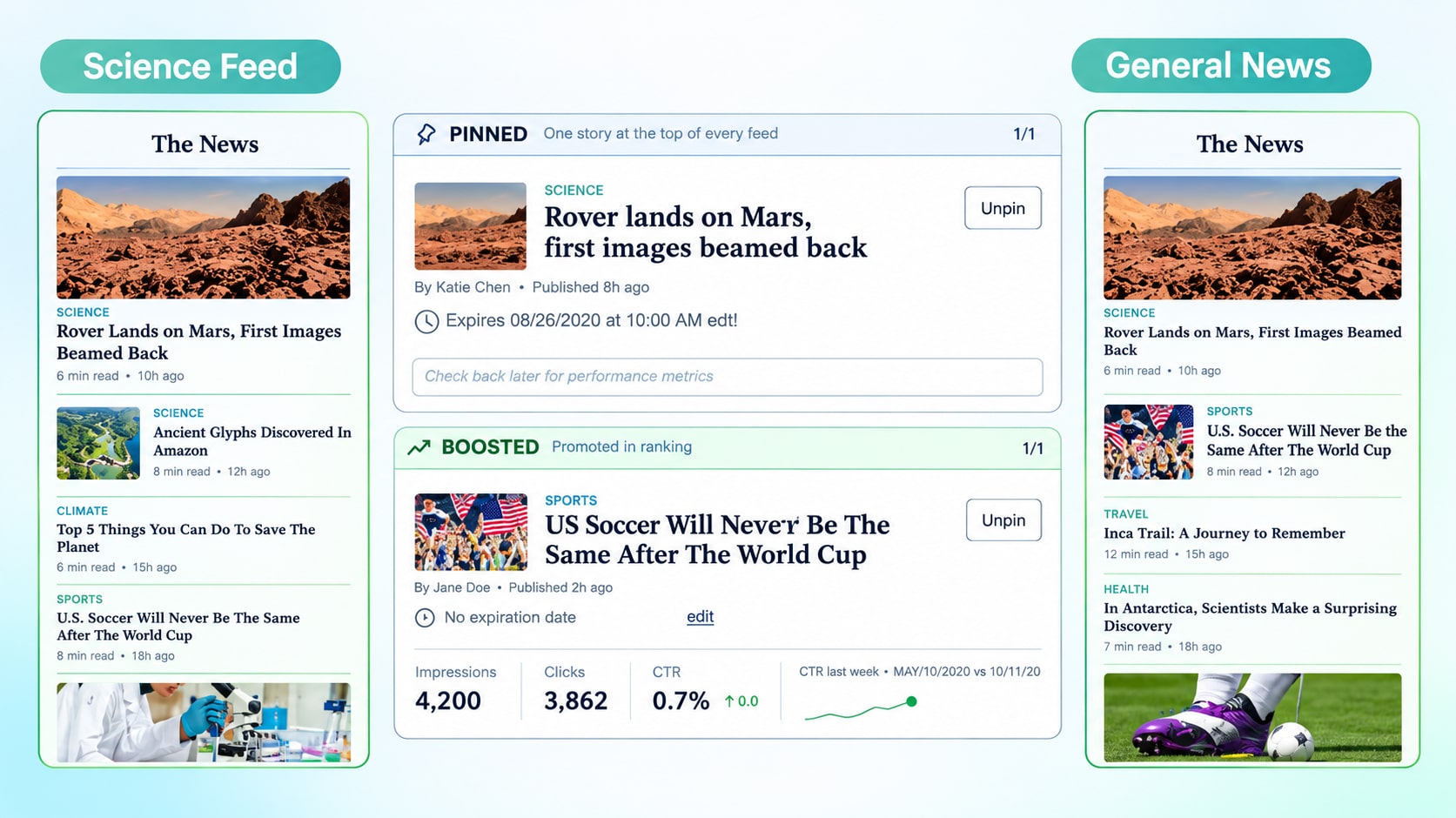
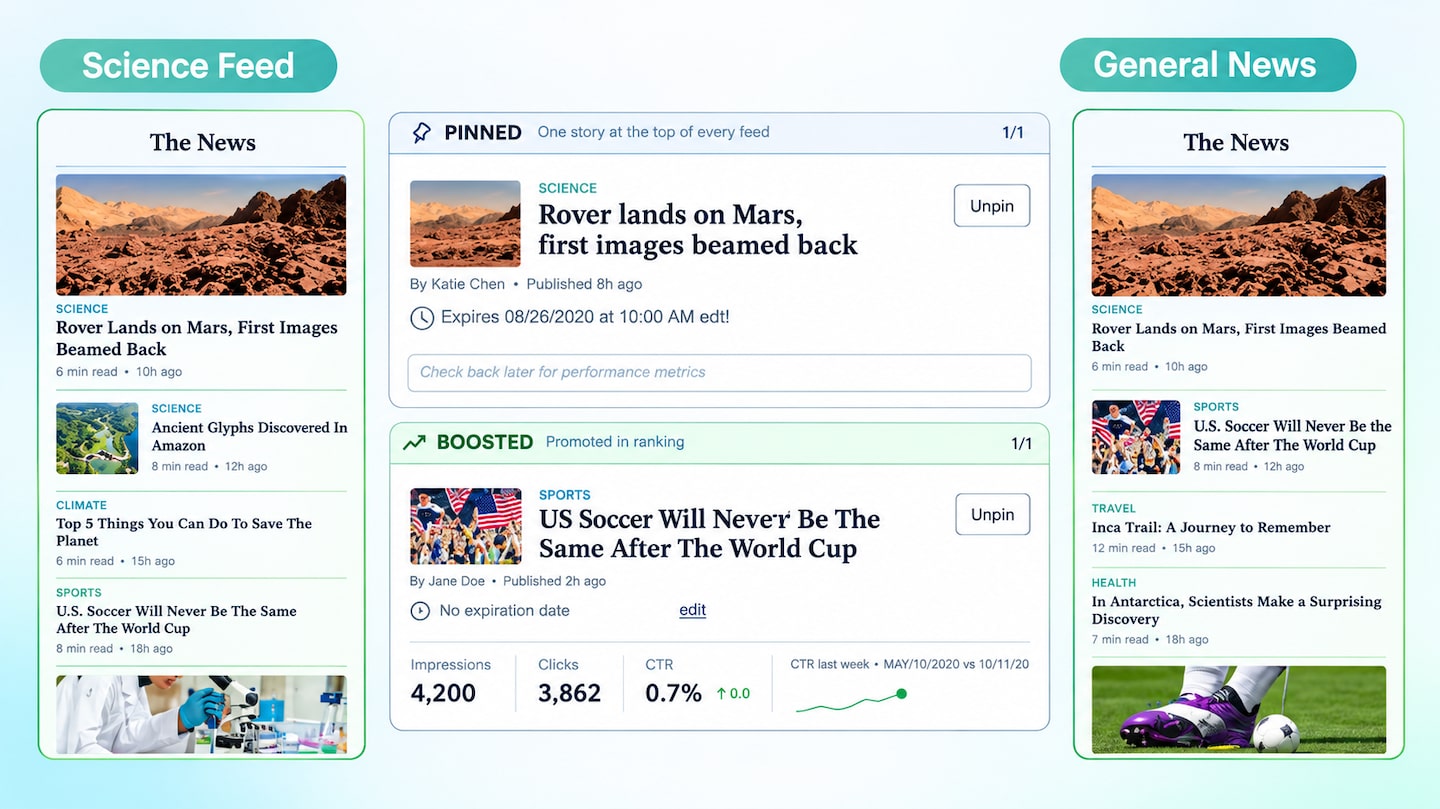
Editorial Priority Controls let editors pin, boost, or bury any story themselves, with no developer involved and no rules to configure. A pin propagates instantly to every reader’s view, above the personalized recommendations. One pin holds at a time; boost and bury are unlimited per site. When news breaks, the newsroom’s call is the one that lands across the audience.
Reporting includes impressions, clicks, and click-through rate per site, so teams can see how personalized placements are performing. Customers can also access deeper engagement reporting, including pageviews per session and active days per reader.
Works with any CMS: No migration, no lock-in, no CDP required
Arc XP Compass is standalone. It works with any CMS or delivery layer, with no requirement to adopt the rest of Arc XP.
Discovery experiences embed into existing home pages and section fronts, and reader events are captured through our Web SDK, so a customer data platform isn’t a prerequisite.
Audience experiences that can’t be duplicated
A general-purpose chatbot can summarize the news. What it can’t reproduce is what a newsroom spends years building: an editorial voice, a reader’s trust, and an archive of original reporting that belongs to the publisher alone. That combination is the one thing no AI product can assemble on a publisher’s behalf.
Arc XP Compass is built to turn that advantage into a daily reason for readers to come back directly, instead of getting a version of the story somewhere else.
See a demo to understand what Arc XP Compass can do for your audience.
Recent resources